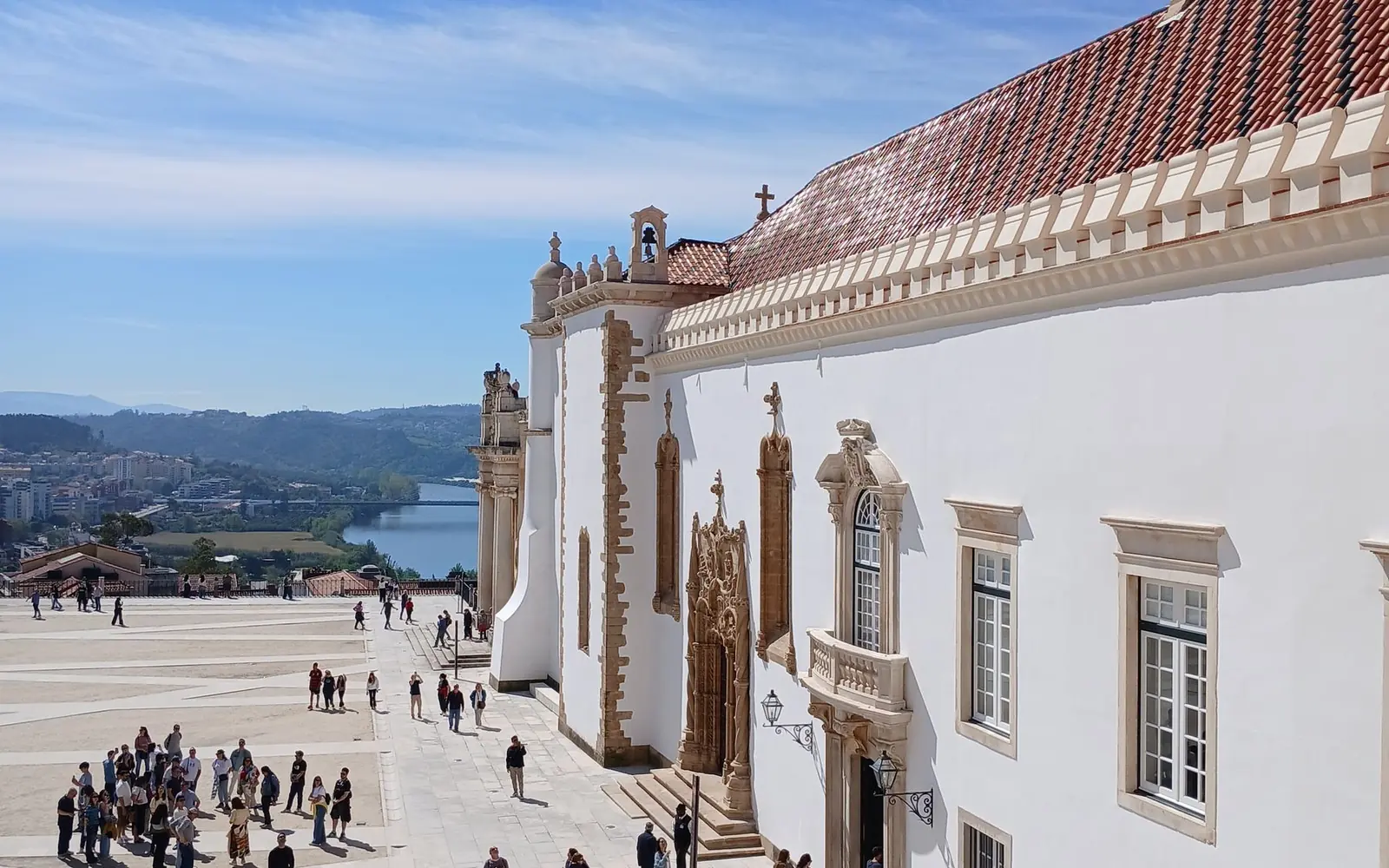
Coimbra is best understood as a university city rather than a quick stop between Lisbon and Porto. The historic university crowns a steep hill, with medieval lanes dropping towards the lower town and the Mondego. One full day covers the main heritage area, while an overnight stay makes the pace much easier.
The University of Coimbra and Rua da Sofia form the core of the city's UNESCO-listed heritage. Student traditions remain visible in academic dress, music and ceremonies, but they are part of a living institution rather than a performance arranged for visitors.
Leave a gap between the station and the library
A Coimbra stop has two separate arrivals: the mainline station and the upper town. Check the station named on your train ticket, then plan the connection into the centre and the climb or local transport to the university. Metro Mondego publishes current local journey information; avoid relying on an old description of a connecting railway service.
The Joanina Library uses a booked admission time. Choose that time after allowing for the station transfer, luggage and a meal. With an overnight stay, use the arrival afternoon for the lower town and keep the university for the next morning. With a same-day stop, reduce the plan to the university and one connected walk, rather than adding distant sights before the onward train.
Continue planning: Other central Portugal stops · Coimbra in the ten-day route · Compare a stop in Aveiro.
Official information: University of Coimbra: Joanina admission · Metro Mondego: local journey planner.
The university and upper town
The Paço das Escolas is the ceremonial centre of the historic university. Ticket options and access arrangements vary between spaces, including the Joanina Library, so use the university's official visitor site before choosing a time. Do not assume every building is included in every ticket.
The Old Cathedral and narrow Alta streets lie below the university. Grouping them on the downhill route avoids repeating the hardest climb. The Botanical Garden also descends from the upper area and can provide a quieter break from stone streets.
Lower town and river
Santa Cruz Monastery, Praça 8 de Maio and the pedestrian streets of Baixa form a flatter route. Cafés and shops here serve local residents and students, giving the lower town a different rhythm from the monumental hill.
Across the Mondego, Santa Clara-a-Velha tells a story shaped by repeated flooding. The west bank also gives broad views back towards the university. Check opening arrangements before crossing specifically for a monument.
A two-day plan
- Day one: Start at the university with a pre-checked entry time. Walk downhill through the Old Cathedral and Alta, then finish in Baixa.
- Day two: Visit the Botanical Garden or riverfront, cross to Santa Clara, and leave time for a museum, café or local performance.
On a one-day rail stop, store luggage first and keep the west bank optional. The university deserves more time than a quick photograph from its courtyard.
Where to stay
Baixa is practical for restaurants, buses and a more level evening. The university quarter has atmosphere but involves steep approaches and can be quiet outside term. Accommodation near the river or main road links may simplify luggage transfers.
Coimbra-B railway station is not in the historic centre. Some trains continue to Coimbra station or connect with local transport. Check the exact station shown on your ticket and the current connection.
Food and student culture
Look for chanfana, leitão from the wider region, pastries associated with convent traditions and local wines from the Bairrada and Dão areas. Menus vary by season and restaurant. The student song tradition known as Fado de Coimbra has its own style and setting, distinct from Lisbon fado.
Getting around
Most visitor areas are within walking distance, but the gradient is the deciding factor. A useful approach is to take a bus or taxi uphill and walk down. Cobbles, steps and historic thresholds make some routes difficult for wheelchairs and pushchairs, so confirm access for individual university spaces.
When to visit
Spring and autumn suit the climbs and garden. Summer can be hot on exposed streets, while winter rain makes polished paving slippery. University ceremonies and academic events can change access or crowd levels, and current notices should take priority over a fixed itinerary.
Nearby trips
Conímbriga is the major Roman site near Coimbra but requires separate transport planning. Aveiro works well as the next rail stop rather than a hurried return trip. The schist villages and mountain areas of central Portugal generally need more time and often a car.
Common planning mistakes
- Do not confuse Coimbra-B with a central old-town station.
- Do not build a route that climbs from Baixa to the university several times.
- Check which university spaces are included before buying a ticket.
- Treat student traditions with respect and do not interrupt academic activity for photographs.
Places to add to your map
- University of Coimbra: Historic hilltop university complex.
- Old Cathedral: Romanesque cathedral below the university.
- Santa Cruz Monastery: Historic church on Praça 8 de Maio.
- Botanical Garden: Terraced garden below the university quarter.
- Santa Clara-a-Velha: Monastic ruins on the west bank of the Mondego.
Open the route planner to place these stops in a wider Portugal trip.
Plan nearby destinations
- Portugal travel guide
- Central Portugal
- Aveiro travel guide
- Nazaré travel guide
- Óbidos travel guide
- Portugal route planner
Questions about Coimbra
Is Coimbra worth staying overnight?
Yes. An overnight stay leaves time for the university, lower town and river without arranging the day around luggage and an onward train.
How long should I allow for the university?
Allow at least half a day if you plan to enter several ticketed spaces. Timed access and visitor flow can affect the order, so check the official booking information.
Is Coimbra easy to walk?
Distances are compact, but the climb from the lower town to the university is steep. Buses or taxis can reduce the uphill section.
Can I visit Coimbra between Lisbon and Porto?
Yes. Coimbra fits naturally into the main rail corridor, but station names and the connection into the centre need checking when choosing a train.
Sources and updates
This guide was last reviewed on 28 August 2026. Transport, access and opening arrangements can change, so check the official source before travel.
- CP passenger information, Comboios de Portugal
- Coimbra World Heritage itinerary, Câmara Municipal de Coimbra
- Visit the University of Coimbra, University of Coimbra
- Coimbra, Turismo de Portugal
Related places to consider
These guides can help you place Coimbra within a wider route.